

Strategy: Clinical Quality Service for First Responders (FirstAidIQ)
Generated from research in Ideas Catalogue. Strategic initiatives created in Aha.io product II65.Strategic Position
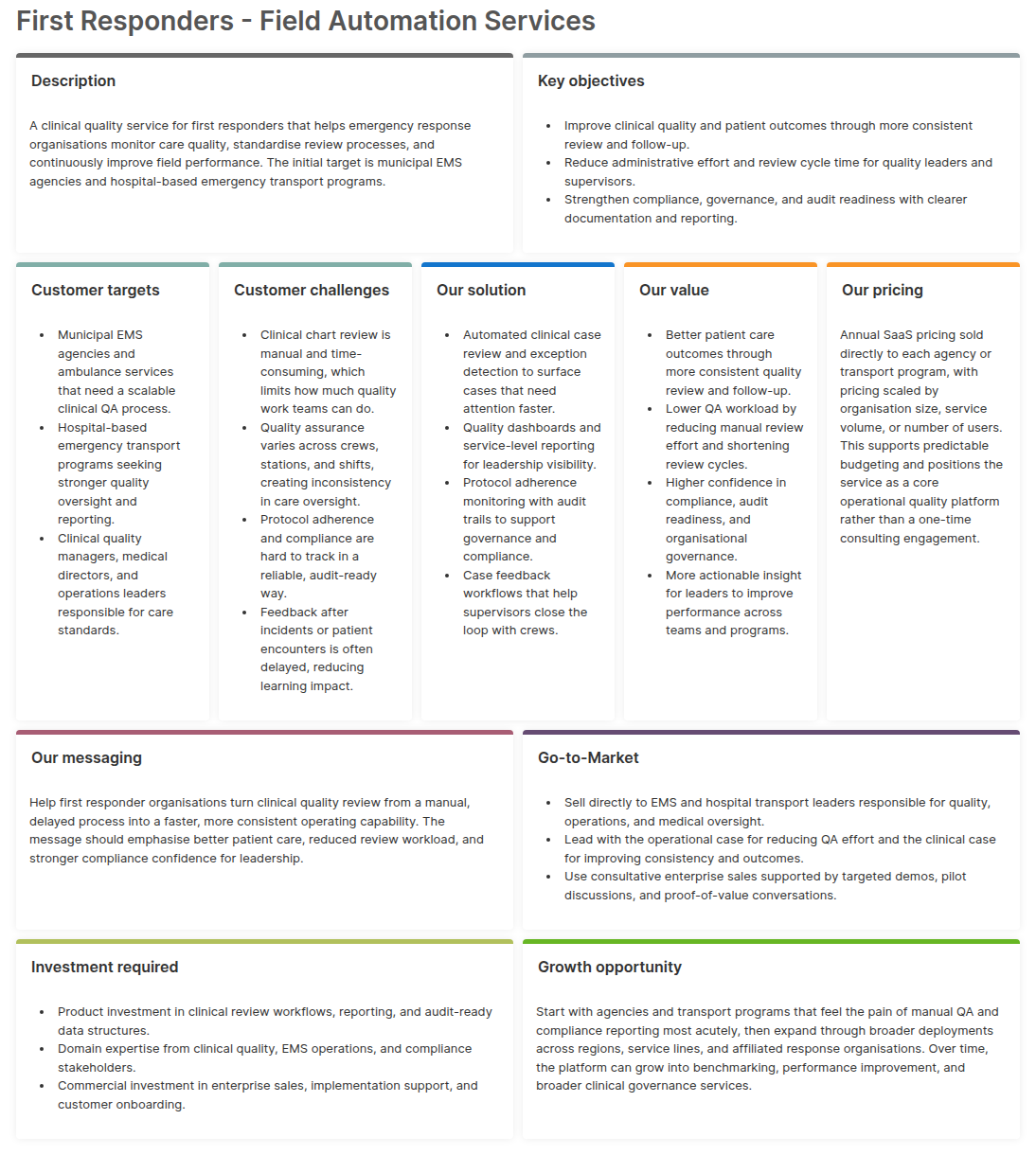
FirstAidIQ is positioned as the Category King in AI-powered pre-hospital clinical decision support. No competitor currently offers an AI-first, voice-guided Clinical Decision Support System (CDSS) designed for field use. Hospital CDSS vendors (Philips, Epic, Cerner) are not optimised for high-stress, hands-busy emergency field conditions. Traditional EMS software (ESO, ImageTrend) lacks AI capabilities. Opportunity window: 2-3 years before hospital CDSS vendors extend into pre-hospital space.Business Model
Market Context
| Metric | Value | Source |
|---|---|---|
| AI in Healthcare Market (2025) | USD 36.96 billion | Precedence Research |
| AI in Healthcare CAGR | 36.83% | Precedence Research |
| CDSS Market (2030) | USD 3.89 billion | MarketsandMarkets |
| Wearable Healthcare (2030) | USD 75.98 billion | MarketsandMarkets |
| First responders globally | 15-20 million | Estimate |
| Pre-hospital error rate | 5-15% of incidents | Clinical studies |
Strategic Initiatives (Aha.io)
II65-S-1: Establish First-Mover Advantage in Pre-Hospital AI CDSS
Capture the 2-3 year window before hospital CDSS vendors extend into pre-hospital space. Key milestones:- NZ pilot live with St John (Q2 2026)
- Published clinical outcome data (Q4 2026)
- TGA (Australia) regulatory approval (Q4 2026)
- 500 active users, AUD/NZD 300K ARR (Year 1)
- UK NHS engagement (Q2 2027)
- 10,000 users, USD 6M ARR (Year 3)
II65-S-2: Clinical Validation & Regulatory Approval Pathway
Clinical evidence is the primary competitive moat. Regulatory approval creates a durable barrier to entry. Regulatory pathway:- NZ: Medsafe Class I/II Software as Medical Device (SaMD) registration
- Australia: TGA ARTG listing for SaMD
- UK: MHRA registration post-Brexit
- US: FDA 510(k) for Class II Clinical Decision Support Software
- Partner with St John NZ as anchor pilot organisation
- Primary outcome metric: reduction in protocol deviation rate
- Target: peer-reviewed publication in Emergency Medicine journal
- Ethics approval from NZ Health and Disability Ethics Committee
II65-S-3: Partner Ecosystem & Integration Strategy
Partner-led distribution reduces CAC by ~40%. Integration depth increases switching costs. Clinical partners:- St John NZ — anchor pilot and clinical guideline source
- Ambulance NZ — national coverage
- Paramedics Australasia — regional expansion
- NHS ambulance trusts (UK) — Phase 3
- Wearable OEMs: Polar, Garmin, Apple (HealthKit), Samsung (Health SDK)
- CAD systems: Hexagon (Priority Dispatch), Motorola Solutions (PremierOne)
- Hospital EHRs: Medtech (NZ), Epic, Cerner
- Telecom: Spark NZ, Vodafone — 5G emergency network priority access
Pricing & Revenue Model
| Tier | Price | Target | Key Features |
|---|---|---|---|
| Starter | USD 49/user/month | Individual paramedics, volunteer services | Basic clinical guidelines, vital sign logging, mobile app |
| Professional | USD 149/user/month | Ambulance services, fire departments | AI voice guidance, real-time telemetry, wearable integration, control centre dashboard |
| Enterprise | USD 499/user/month | Regional emergency services, hospital networks | Full platform, custom protocols, API integrations, advanced analytics |
| Government | USD 50K+/year | National/regional government agencies | Multi-org deployment, national guideline integration, data sovereignty |
| Platform | Revenue share / licensing | Technology partners, device manufacturers | SDK access, white-label licensing |
| Year | Users | ARR |
|---|---|---|
| Year 1 | 500 | USD 300K |
| Year 2 | 2,500 | USD 1.5M |
| Year 3 | 10,000 | USD 6M |
| Year 5 | 50,000 | USD 30M |
Go-to-Market Roadmap
| Phase | Timeline | Focus | Target |
|---|---|---|---|
| Phase 1: Foundation | Months 1-6 (2026) | Build core platform, partner with St John NZ | 50-100 pilot users |
| Phase 2: Validation | Months 6-12 (2026) | Clinical data collection, regulatory submission | 500 users, published results |
| Phase 3: Expansion | Months 12-24 (2026-2027) | Australia and UK market entry | 2,500 users, AUD 1.5M ARR |
| Phase 4: Scale | Months 24-36 (2027-2028) | US market, platform SDK | 10,000 users, USD 6M ARR |
Risk Assessment
| Risk | Likelihood | Impact | Mitigation |
|---|---|---|---|
| Regulatory delay (NZ/AU) | Medium | High | Early ethics and regulatory engagement, pre-submission meetings |
| Clinical adoption resistance | Medium | High | User-centred design, clinical advisory board, pilot champions |
| Hospital CDSS vendor extension | Low (2-3 year window) | High | Build regulatory and clinical evidence moat before window closes |
| Data breach or privacy incident | Low | Critical | Security-first architecture, annual penetration testing, cyber insurance |
| Key personnel departure | Medium | Medium | Documentation, competitive retention packages |
Strategy document generated 2026-04-30. Source: Ideas Catalogue research (IDEAS-I-30-clinical-quality-first-responders). Aha.io product: II65.